
Clay County Schools were closed Monday, Oct. 26, 2026, for repairs following a water pressure issue resulting in bathroom access disruptions at Clay County High School, which received major attention after a Clay County High School student reported on social media about the conditions. Now, following the closure and maintenance, school officials say were in the works prior to the public report on social media, the school system has replaced the water valve and water pressure regulator at Clay County High School and believes the water pressure problem that disrupted restrooms there is fixed – Superintendent Philip Dobbins told The Clay Communicator.
“Based on our assessment at this time, these components appear to have been the source of the water pressure problem, and we believe the issue is resolved,” Dobbins said in written responses to the newspaper’s questions on Tuesday, Oct. 27.
The parts were replaced Monday, Oct. 26, when the high school was closed so the repairs could be completed. Dobbins confirmed the new regulator replaced the component named in the district’s Oct. 19 statement. “The regulator was the component referenced in our October 19 statement,” he said. The district also provided two photographs of the newly installed parts.
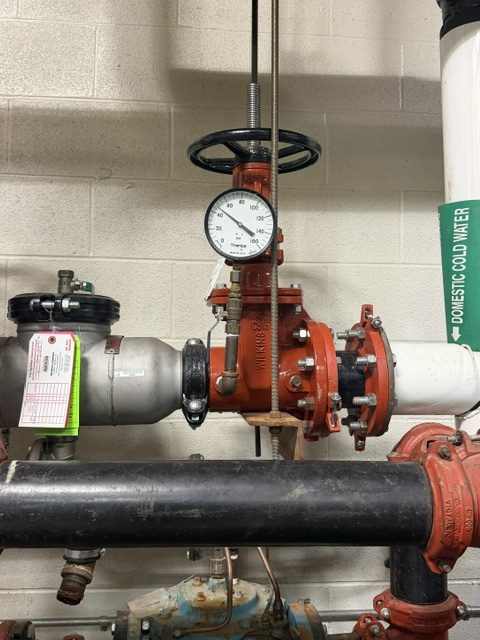
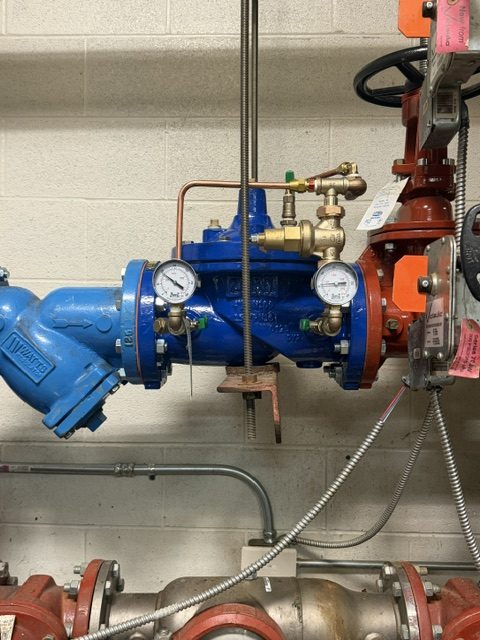
Dobbins said every restroom was open when students returned and that the district will continue to monitor the problem. He also answered questions about school meals raised in that same public letter from a CCHS student that has drawn wide community support.
From the Oct. 19 statement to Monday’s repair
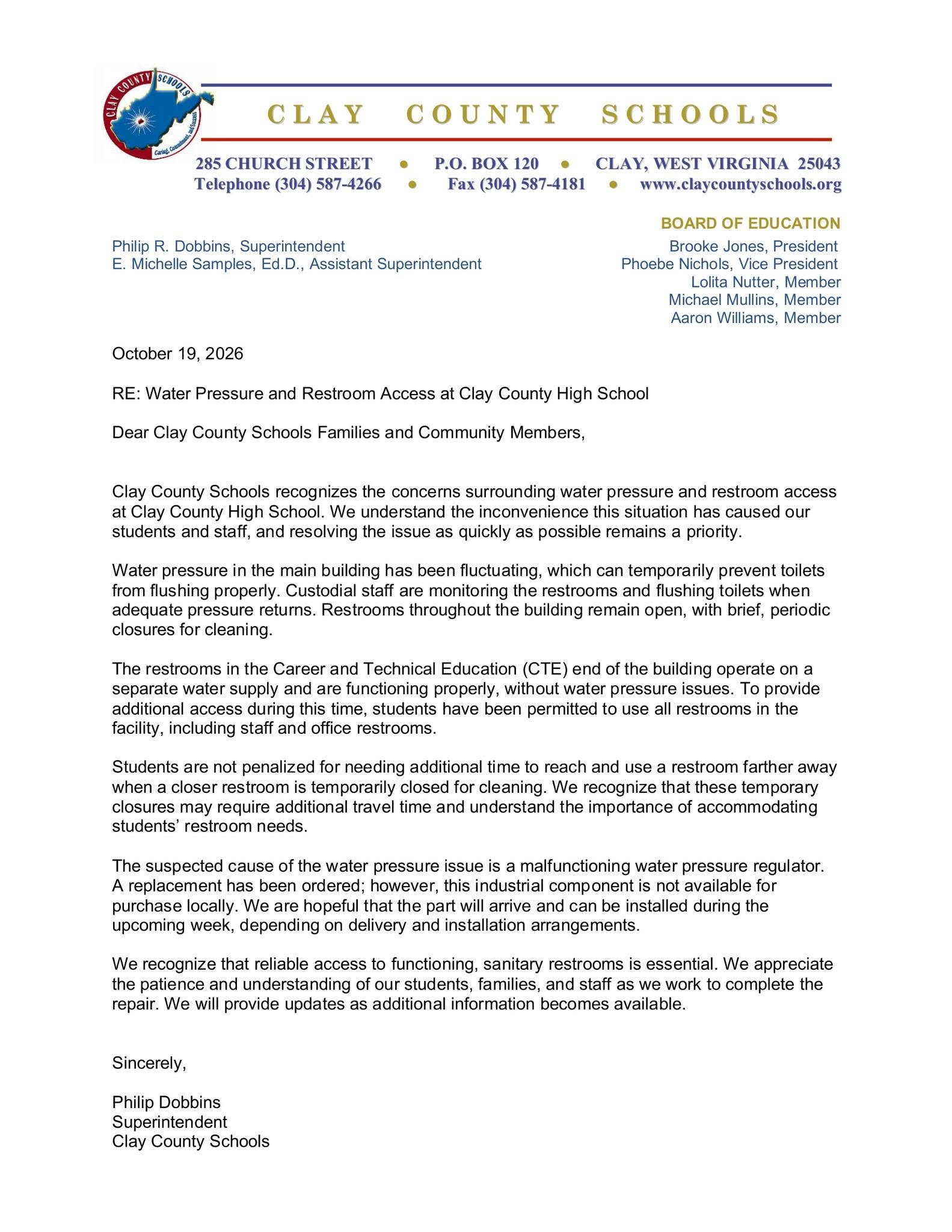
As The Clay Communicator reported Oct. 19, Dobbins said then that fluctuating water pressure in the school’s main building had kept some toilets from flushing properly. Custodial staff were flushing toilets when pressure returned and monitoring restrooms, students were allowed to use staff and office restrooms, and the district said students would not be penalized for extra time spent walking to restrooms farther away. At the time, officials suspected a malfunctioning pressure regulator and had ordered a replacement part.
Asked whether any follow-up monitoring or inspection is planned to keep the problem from returning, Dobbins answered, “Yes.”
Superintendent disputes single-restroom accounts
Some students have said upstairs and downstairs restrooms were locked during the water problems, leaving a single three-stall restroom for more than 500 students.
Dobbins disputed that account.
“As stated in my previous letter to the public, certain restrooms were closed briefly during our water pressure issues so they could be cleaned and properly serviced. However, at no time were students limited to only one three-stall restroom for use.”
Superintendent Dobbins
He also took issue with the student count. “CCHS does not have 500 students present on any given day,” Dobbins said. “Our current enrollment is approximately 460 students, and that figure includes virtual students who are not physically on campus each day.”
“Student health, safety, and access to facilities remain a priority,” he said. “All school restrooms are currently open and available for student use, and we will continue to monitor facilities to ensure they remain clean, safe, and fully operational.”
Student letter raises meal concerns
The student’s letter, which has circulated widely in the community, describes breakfast biscuits that are often hard or dry, lunch options that repeat frequently and, on Oct. 19, an insect found on a student’s lettuce. The letter also asks whether purchases such as new iPads have taken priority over food.
In his responses, Dobbins focused on how CCHS meals are scheduled, prepared, planned and paid for.
Breakfast schedule and grab-and-go meals
Asked whether the daily schedule, including how much time students have for breakfast, contributes to the reliance on prepackaged grab-and-go meals, Dobbins said it does play a part.
“The daily schedule does play a role in how breakfast is served, and schools are required to operate within both federal and state nutrition program guidelines,” he said.
He explained that the U.S. Department of Agriculture requires schools to offer breakfast through one or a combination of three approved models: grab-and-go breakfast, breakfast after first period or breakfast in the classroom. Under any of those models, students must be offered four food items and must take at least three for the meal to qualify for reimbursement.
“Every item offered through our breakfast program meets all applicable federal and state nutritional standards,” Dobbins said.
“The use of grab-and-go items is not solely a result of scheduling,” he added. “Rather, it is one of the approved methods designed to increase student access to breakfast.”
Dobbins said the approach is reaching more students. Breakfast participation at CCHS rose from 27% of students in September 2025 to 70% in September 2026, according to the district, while lunch participation rose from 52% to 54% over the same period.
Meal Participation at CCHS
70%
Breakfast in September 2026
Up: +43 since Sep. 2025
54%
Lunch in September 2026
Up: +2 since Sep. 2025
Source: Clay County Schools
“The results this year indicate that the current approach is helping more students participate in school nutrition programs,” he said.
How CCHS meals are prepared
Dobbins said the high school uses a mix of food cooked on site and prepackaged products.
“Some items are prepared from scratch or cooked and assembled in our school kitchens, while others are purchased as prepackaged products from approved food vendors,” he said, adding that the approach allows the district to offer variety while maintaining food safety, consistency and compliance with nutrition standards.
“Menu planning is carefully overseen by our cafeteria managers and the County Foods Director,” Dobbins said. Menus are entered into menu-planning software that checks recipes and food items against USDA requirements for calories, sodium, whole grains, fruits, vegetables and other standards. Cafeteria managers, building administrators and the County Foods Director monitor food quality, meal service and program compliance throughout the school year, he said.
Comparison with Kanawha County
Kanawha County Schools recently shared a reel on Facebook of freshly cooked breakfast items. Asked whether Clay County is considering similar approaches, Dobbins said the two districts buy from many of the same sources.
“It is important to note that Clay County Schools and Kanawha County Schools participate in the same Foods Cooperative and purchase many of the same food products from the same approved vendors,” he said. “As a result, many of the ingredients and menu items available to both school systems are very similar.”
On concerns about repeated meals, Dobbins said “our menus operate on a five-week cycle, which allows us to rotate offerings and avoid excessive repetition while still meeting nutritional standards.”
“We will continue to evaluate best practices used by other districts, including Kanawha County, and incorporate improvements that are practical, beneficial for students, and consistent with the requirements of the School Nutrition Program,” he said.
Food money separate from iPads, superintendent says
Responding to the student’s question about iPads, Dobbins said the two kinds of spending come from different pots of money.
“The funding used to purchase food and operate school meal programs is completely separate from the funding used for technology purchases such as iPads, computers, or other instructional technology,” he said.
School nutrition programs are funded through federal and state reimbursements for meals served and through revenue generated by the School Nutrition Program, Dobbins said. “These funds are restricted and must be used for allowable food service expenses, such as purchasing food, kitchen equipment, supplies, and supporting cafeteria operations.”
Student devices are paid for through separate budget sources set aside for instructional technology. “Those funds cannot simply be redirected to purchase food, just as school nutrition funds cannot be redirected for technology purchases,” he said.
“As a result, purchases such as new iPads have not taken priority over food services.”
Superintendent Dobbins
No set timeline for meal changes
Asked whether families can expect a timeline for meal improvements, Dobbins said the program is reviewed continuously rather than on a fixed schedule.
“Rather than having a single timeline for meal improvements, the School Nutrition Program is reviewed on an ongoing basis throughout the school year,” he said. Adjustments are made based on student preferences, participation rates, product availability, nutrition requirements and program performance.
“While we are encouraged by these results, we recognize that there is always room for improvement,” Dobbins said. He said the district will continue to review menus, look at practices in other districts and seek feedback when appropriate.
“Our commitment is to continuous improvement, and families can expect Clay County Schools to keep working toward enhancing both the educational experience and the nutrition program in ways that best serve our students,” he said.
The Clay Communicator will continue to follow conditions at Clay County High School. Students, parents and staff with information to share can reach the newsroom at news@theclaycommunicator.com.


Leave a Reply