This Saturday morning, families from across Clay County gathered inside Clay County High School to celebrate one of the most meaningful milestones in a young person’s life: graduation.
The Clay County High School Class of 2026 officially received their diplomas on Saturday, May 30, around 10:00 a.m., marking the end of thirteen years of schooling and the beginning of a new chapter for dozens of local students.


Graduation ceremonies have long held a unique significance in rural West Virginia communities. In counties like Clay, where generations of families often attend the same schools, commencement is not simply an academic event. It is a community tradition — one that reflects perseverance, resilience, and the collective investment families make in their children’s futures.
For many seniors, graduation represents years of hard work shaped not only by coursework and athletics, but also by the realities of growing up in rural Appalachia. Students have balanced academics alongside jobs, family responsibilities, sports, band, FFA, church activities, and community obligations. Many will become first-generation college students. Others will enter the workforce, military service, technical programs, or remain in the region helping sustain local industries and communities.

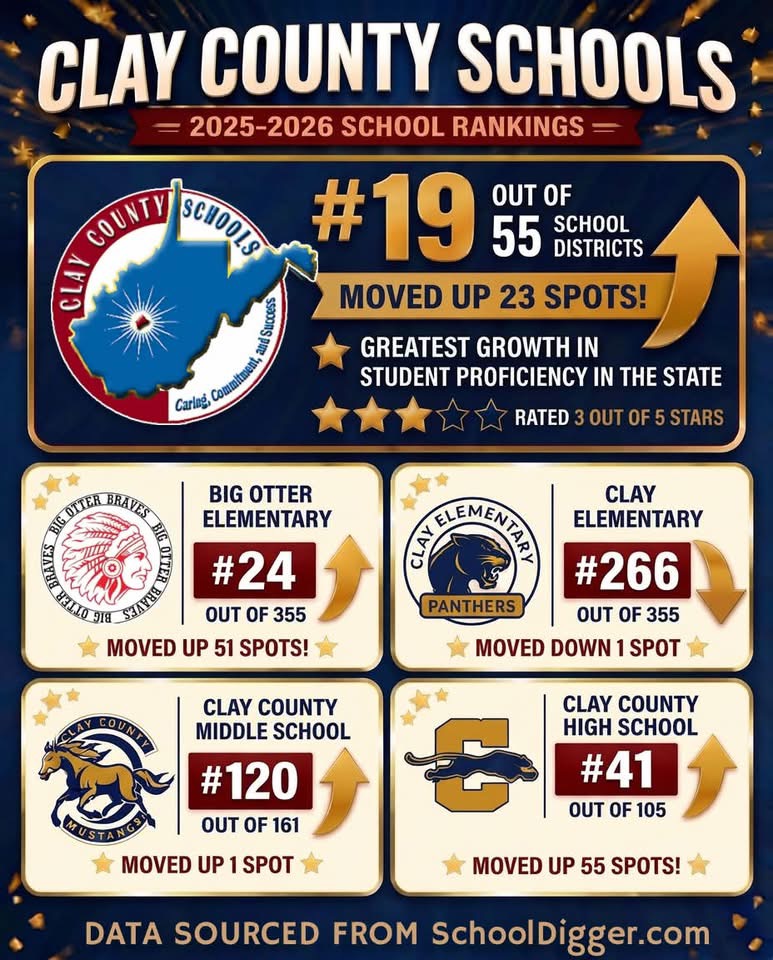
Clay County High School itself has remained deeply embedded within the social life of the county. Throughout the school year, the school has hosted events ranging from theater productions and music performances to career fairs and signing days recognizing students entering employment or continuing education pathways.

In many ways, rural schools serve functions extending far beyond education alone. They act as gathering places, cultural centers, and institutions of community identity. Particularly in smaller Appalachian counties, the local high school often becomes one of the few remaining public spaces where entire communities regularly come together.
Graduation ceremonies reflect that broader communal role.
Across West Virginia, commencement season carries symbolic weight because education has historically represented both opportunity and mobility within Appalachian communities. For generations, parents and grandparents have viewed graduation as evidence of sacrifice rewarded — the culmination of years spent supporting children through economic hardship, long work hours, transportation challenges, and the unpredictability that often accompanies rural life.
Yet graduation in modern Appalachia also exists alongside uncertainty.
Many graduating seniors face difficult decisions about whether to remain in West Virginia or leave in pursuit of educational and economic opportunities elsewhere. Rural population decline and workforce shortages continue affecting counties across the state, creating tension between local attachment and economic necessity. For some students, graduation becomes both a celebration and a crossroads.
That shift reflects broader changes in how rural education is increasingly understood. Success after graduation is no longer framed solely through four-year college attendance, but through a range of pathways including skilled trades, healthcare, technical certification programs, entrepreneurship, military service, and community leadership.
Still, commencement ceremonies remain rooted in tradition.

Graduation day in Clay County included packed bleachers, emotional speeches, proud grandparents, photographs in Panther blue and gold, and the familiar mixture of excitement and uncertainty that accompanies transition. For parents, it is often difficult to separate pride from nostalgia. For students, the moment frequently arrives with the realization that childhood routines — bus rides, classrooms, football games, pep rallies, and lifelong classmates — have changed permanently.
But perhaps what makes rural graduations particularly meaningful is their collective nature. In communities like Clay, students are rarely raised by parents alone. They are raised by extended families, neighbors, teachers, coaches, pastors, bus drivers, cafeteria workers, and entire networks of community care. Graduation therefore becomes not just an individual achievement, but a communal one.
This year’s graduating class enters adulthood during a period of significant transition for West Virginia itself. The state continues confronting challenges surrounding healthcare access, economic development, childcare shortages, population decline, and educational inequality. Yet graduation season also serves as a reminder that the future of rural communities ultimately rests with young people preparing to step into adulthood.

For the Class of 2026, Saturday’s ceremony marked the close of one chapter and the beginning of another.
And for Clay County, it serves as a reminder that even in times of uncertainty, the accomplishments of its young people remain among the community’s greatest sources of hope.