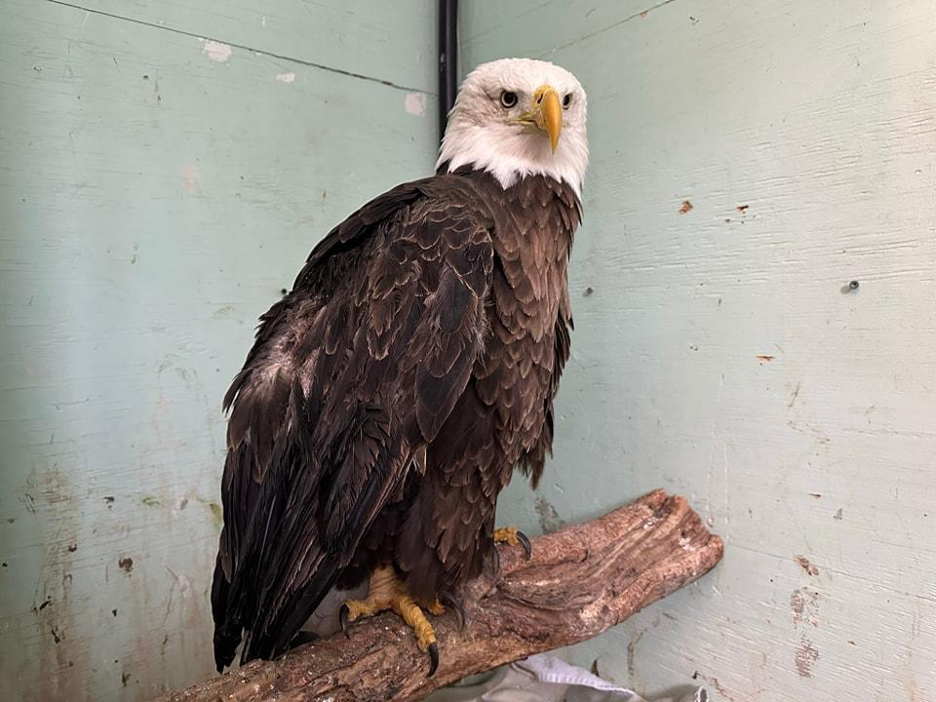
In a town where residents are no strangers to lending a hand, Clay County united once more in a time of need. When an injured bald eagle was found in distress, local residents Gary King and Dennis McLaughlin quickly reached out to medical professional Vicki Dobbins, and the three joined forces to care for the bird until it could be safely transported to Three Rivers Avian Center. Their teamwork reflected the strong sense of community and shared responsibility present in small towns like Clay County.
A wounded bald eagle, nicknamed “Clay,” is slowly recovering from his injuries. What started as an emergency rescue, Clay’s story has now become a testament to resilience, environmental awareness, and the impact a community can have on local wildlife.

It was discovered early on that the bald eagle needed medical attention and was diagnosed with dangerously high levels of lead in his blood, which measured at 49.9 micrograms per deciliter. Lead poisoning in birds of prey is generally caused by consuming fragments of lead ammunition left in carcasses, meaning the cause likely came from an unknowing local.


In addition to lead poisoning, Clay was facing other troubles with his damaged wing, making recovery even more difficult. Treating either condition alone would be challenging, but together they require careful, long-term rehabilitation. Wildlife experts immediately began working on the problem by administering chelation therapy, which is typically used to flush lead from the bloodstream. Encouragingly, Clay’s lead levels gradually declined, reaching 5.4 micrograms per deciliter by April.
Clay also underwent a range of treatment options, such as hydrotherapy and laser therapy, to promote healing and reduce any inflammation in his body. As he began to recover, he was moved to a larger aviary where he could move more freely.
Recovery has not been without setbacks. While adjusting to his new aviary, Clay fell and further injured his wing, necessitating a change in his recovery program.
Another challenge has been maintaining the eagle’s weight. Irregular eating habits are common in injured animals, and workers have been carefully managing his feeding patterns to restore his health without causing additional stress.
Despite these challenges, support from the community has remained strong. Residents have come forward to help Clay in every way possible. One of the most significant contributions came from the Tate Lohr Fish Hatchery, which supplied food to help maintain his health.
Clay’s case has also sparked discussion about environmental protection. Lead exposure remains a great threat to raptors in West Virginia and beyond. As conservationists note, using non-lead bullets would greatly mitigate this risk and allow for the protection of species such as the American Bald Eagle, whose numbers were close to zero not long ago. In Clay County, a community where hunting is widely practiced, a switch to non-lead bullets could make an impact in wildlife conservation across the region.
Clay is no longer just another animal in rehabilitation. In addition to representing the state of local ecosystems and dangers posed by people’s actions, he stands as an illustration of how important collective efforts can be in saving animals from deadly fates.
Although much work lies ahead before Clay’s release, his progress shows the level of attention and treatment he has received. It is hoped that with some more luck and consistent effort, the time will soon come when this famous bird will fly over the town of Clay County once again.
In the meantime, residents can continue following Clay’s story and try to make their own contribution to protecting local wildlife.